

HIPAA Compliance Solutions Built for Healthcare Providers
Understand your risk. Protect patient information. Cube IT helps healthcare providers see where they actually stand, close the security gaps that matter, strengthen safeguards, and maintain HIPAA security readiness that fits how the practice really runs.
Built for Providers, Not for Hospital Systems
Our work is sized for organizations that need real security expertise but do not have a security department. If you already have a chief information security officer and a dedicated compliance team, you probably do not need us. If security currently lands on a practice manager or an office IT contact, you are exactly who this is for.
That includes practices running several locations, where the harder problem is rarely any single control. It is that one site kept the old wireless network, another has a vendor with standing remote access nobody at headquarters remembers approving, and no one holds a complete picture of either.

Six Areas Where Healthcare Organizations Bring Us In
Every engagement starts from what your organization already has in place. We are not replacing your IT support or your clinical systems. We are the security and risk layer above them, translating what we find into decisions your leadership can actually make.
HIPAA security risk assessment
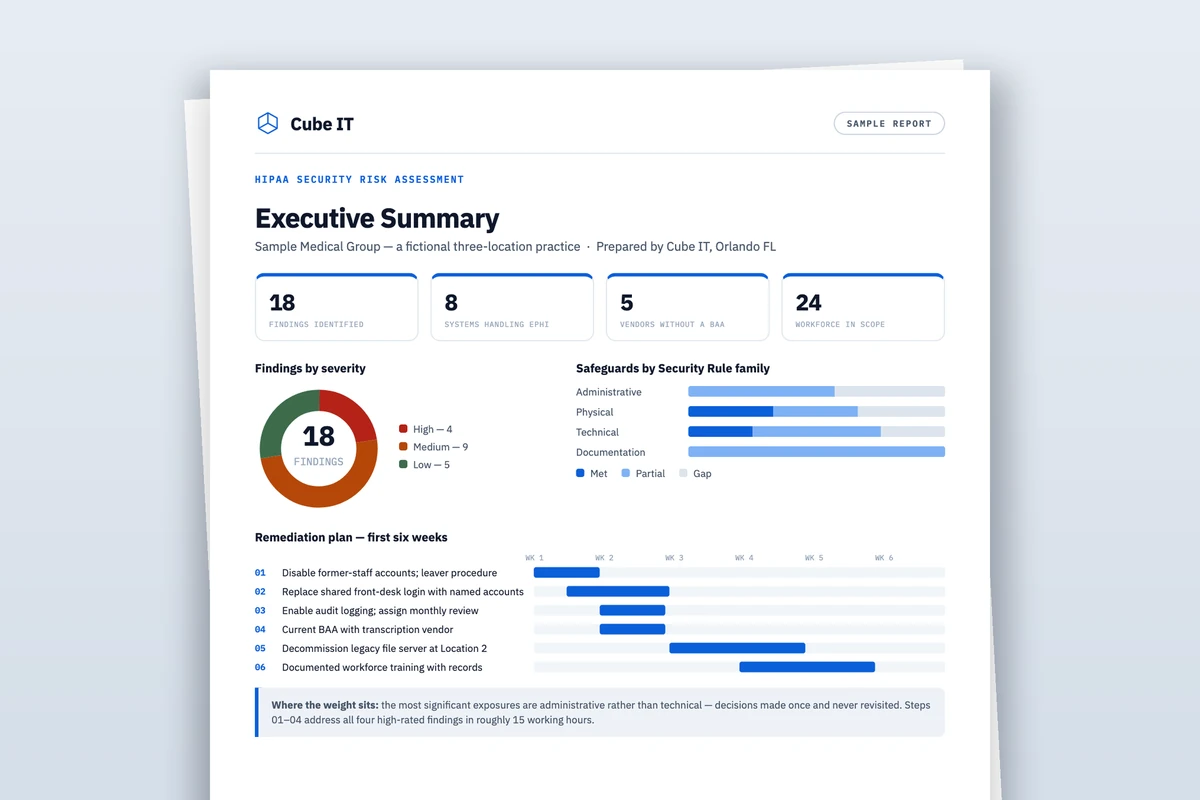
A structured review of how protected health information moves through your organization, where it is exposed, and how your current safeguards measure against the Security Rule.
Security gap analysis and remediation planning
A prioritized picture of what is missing or weak, with a remediation plan sequenced by risk and by what is realistic for your team and budget.
Policies and documentation
Security policies written from what we observed, not downloaded from a template.
Workforce security awareness training
Training built around the situations healthcare staff actually meet during a working day.
Business associate and vendor risk
A clear view of who handles your patient data, and under what agreement.
Ongoing HIPAA security program management
Security readiness treated as something you maintain, with a regular cadence of review, reporting and advisory support instead of a once-a-year scramble.
What the Security Rule Asks For, and How We Assess It
The HIPAA Security Rule requires a risk analysis, reasonable administrative, physical and technical safeguards, and active management of the risks you identify. It is deliberately flexible, so what counts as reasonable depends on your size, your complexity and the risks you actually face. That is why a generic checklist rarely answers the question you are really asking.
Our risk analysis is not a questionnaire you fill in alone. We work through your environment with the people who run it, then rank what we find by what matters most at your size. We also track the Security Rule updates federal regulators have proposed, which are not current law.
Where your data lives
A practical map of the systems, devices and services that create, receive, store or transmit protected health information, including the ones nobody documented.
Who can reach it
A review of access, roles and privileges, including former staff, shared accounts and remote or vendor access paths.
What is protecting it
An evaluation of your administrative, physical and technical safeguards as they are implemented today, not as they were intended.
What to do first
Findings ranked by risk and effort, so the first thing you do is the thing that reduces the most exposure.

Done Once, Then Left Alone
Training, documentation and business associate agreements fail the same way. Each is a decision made at one moment, then treated as permanent while staff, systems and vendors keep changing underneath it.
The attack arrives at the front desk
An attachment that looks like a referral. A message that looks like a payer. We build training on the situations your staff meet. Training reduces risk. It does not eliminate it, and we will never tell you otherwise.
Policies that describe you
A downloaded template drifts, and a policy that no longer describes how you actually operate creates exposure of its own. We write from what the assessment observed, then set the review cadence.
Data outside your building
Records, billing, transcription, imaging, backup, IT support. Does a signed business associate agreement exist for every vendor that needs one, and has anyone checked how those vendors protect the data once they have it?
Documentation You Can Actually Use
Everything we produce is written to be read by two audiences: the leadership team making decisions, and anyone who later needs to understand how those decisions were reached.

Not Sure Where Your HIPAA Security Program Stands?
Tell us what is driving the conversation, whether it is a risk assessment, audit finding, compliance question, cyber insurance requirement, or concern about how patient information is being protected.
We’ll help you understand where to start and what your next steps should look like.
What This Work Does, and What It Does Not Do
We would rather be clear about this before you engage us than have you discover it afterwards. Anyone in this field promising certainty is selling something we are not.
Cube IT is a cybersecurity and risk advisory firm. We are not your auditor and we are not your attorney, and we work alongside those partners rather than replacing them.
What it does
What it does not do
Working Alongside Your Auditors, Counsel and Compliance Partners
What we do is the security work those partners depend on. When an auditor or compliance consultant asks whether a risk analysis has been performed, whether safeguards are implemented, or whether staff have been trained, we are the ones who did that work and documented it.
Organizations bring us in ahead of an audit, an insurance application or a payer requirement, and equally often after someone else has already raised findings and the technical remediation needs an owner. We work with your existing IT provider rather than replacing them, giving them a prioritized roadmap instead of a list of complaints.

Start With Clarity, Then Decide How Much Support You Want
Most healthcare organizations begin with an assessment, because it is difficult to plan or budget for security without first knowing where you stand. What happens after that is a genuine choice, and it depends on whether you have the internal capacity to carry the work forward yourself.

SecureStart — establish the baseline
A structured engagement that assesses your current HIPAA security posture, identifies gaps against the Security Rule, and produces a prioritized remediation plan you own. Right for organizations that need a clear, defensible picture before committing to anything longer.

CyberGuardian — keep the program running
Ongoing security program management for organizations that want the work maintained rather than repeated. Regular review, reporting, advisory access and a security partner who already knows your environment when a question comes up.
A Security Partner That Speaks Plainly
Healthcare organizations have usually been sold security before. Often what arrived was a scan report nobody could act on, or a platform subscription that quietly became somebody else's job to maintain.

We explain, not just report
Findings are delivered in language your leadership can act on, with the reasoning shown. If we cannot explain why something matters to your organization, it does not belong in the report.

Sized for organizations without a security team
We work with practices where security sits alongside somebody's real job. Recommendations are shaped around the capacity you actually have, not the team you would need to hire.

We tell you what we cannot promise
No guaranteed compliance, no certification, no promise that a breach will never happen. Clear scope and honest limits, stated up front and in writing.
How an Engagement Actually Runs
An assessment describes a moment. Then staff change, a new system goes in, a vendor is added, and the picture starts drifting away from the document almost immediately. Organizations that stay in good shape are rarely the ones with the best report; they are the ones who treat readiness as maintained rather than achieved. The sequence below is built for that, and nothing in it disrupts patient care.
Consultation
A conversation about your organization, your systems, what prompted the call, and what you are actually trying to achieve. We tell you honestly whether we are the right fit before anything else happens.
Discovery and assessment
We map where protected health information lives and moves, review access and safeguards, and speak with the people who run the systems day to day. Scheduled around your operating hours, not through them.
Findings and risk review
We walk your leadership through what we found and what it means in business terms, with risks ranked rather than listed. You get the chance to challenge our reading before anything is finalized.
Remediation planning
A sequenced plan with owners, effort and priority, built around what your team and budget can realistically carry.
Remediation support
We can support the work directly, or hand the roadmap to your existing IT provider and stay available to them while they carry it out.
Ongoing program management
A set cadence for revisiting risks, safeguards and documentation, reporting written for the people making budget decisions, and somebody to call before adding a vendor or changing a system rather than afterwards. This is where virtual CISO support usually takes over.
Questions Practices Ask Before They Call
Does Cube IT certify our organization as HIPAA compliant?+
No. There is no official HIPAA certification, and the Department of Health and Human Services does not recognize private HIPAA Security Rule certifications as relieving an organization of its HIPAA obligations. What we provide is an assessment of your security posture, documentation of your risk analysis and decisions, and a plan for improving your safeguards. Be cautious of any vendor offering to certify you as HIPAA compliant.
Is a HIPAA security risk assessment actually required?+
The HIPAA Security Rule requires organizations handling electronic protected health information to conduct an accurate and thorough risk analysis and to manage the risks it identifies. It is one of the foundational requirements of the rule, and it is also one of the most commonly missing or outdated pieces we encounter.
Do we have to perform a HIPAA security audit every year?+
The Security Rule as it currently stands requires that your risk analysis be accurate and current, and that it be reviewed and updated as circumstances change, rather than prescribing a fixed annual security audit for every provider. The Department of Health and Human Services has proposed significant updates to the Security Rule that would introduce more prescriptive requirements, including regular compliance audit expectations. Those changes remain proposed and are not current law. In practice, most organizations find that reviewing at least annually, and whenever systems, vendors or staffing change materially, is the only way to keep the analysis genuinely current.
How long does an assessment take?+
It depends on the size of your organization, the number of locations, and how many systems handle protected health information. We scope it during the initial consultation and tell you the timeline before you commit, rather than discovering it partway through.
Will this disrupt patient care?+
It should not. Most of the work is review, documentation and conversation with the people who run your systems. Anything that touches live systems is planned with you in advance and scheduled around clinical hours.
Can you work alongside our auditor, counsel or existing compliance consultant?+
Yes, and that is usually how it goes. We are not an auditor and not a law firm. We do the technical security assessment and remediation work those partners rely on, and we are comfortable producing evidence and answering questions directly for them.
What if we have never done any of this before?+
That is a common starting point and not something we treat as a failing. Starting from nothing is often simpler than untangling a half-finished program built from templates. We begin with where you are and build from there.